Why Baby Carriers Never Seem to Adjust Long Enough for Tall Moms
Quick Answer: Most baby carrier strap and panel adjustment ranges are built around average torso length, which means taller moms often max out the adjustment before achieving proper baby positioning — carriers with an adjustable torso panel (not just strap length) and checking a brand’s specific torso height range before buying both solve this more reliably than just buying a bigger size.
A carrier that seems to fit in the store can reveal its limits within the first real babywearing session, and for taller moms, that limit is usually the torso panel, not the straps themselves.
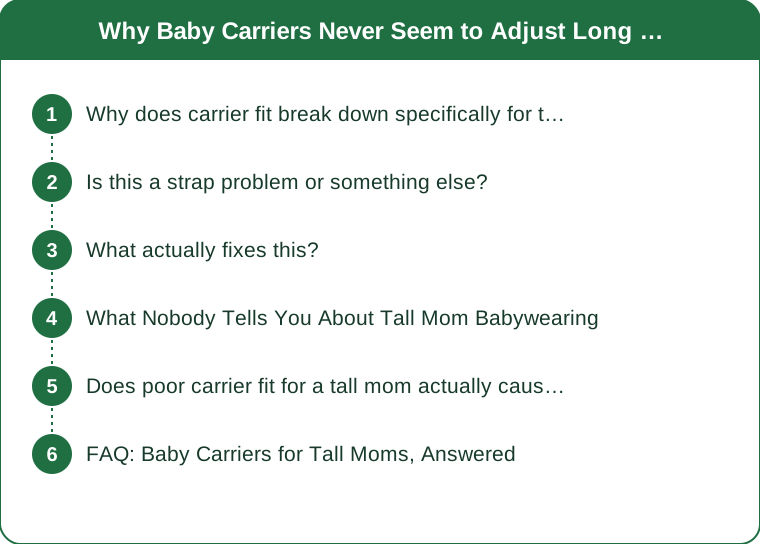
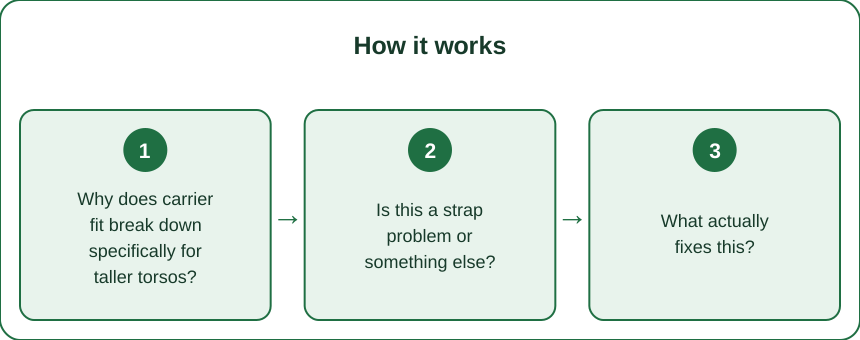
Why does carrier fit break down specifically for taller torsos?
Most baby carriers are designed around an average adult torso length range, with strap and buckle adjustments calibrated to that range — a longer torso pushes the practical adjustment limits, often resulting in the baby sitting lower than the ideal chin-level-to-kissable-height positioning that proper ergonomic babywearing guidelines recommend.
Is this a strap problem or something else?
More often a torso panel problem than a strap length problem specifically. The panel — the fabric section that runs from your shoulders to the baby’s seat — has a fixed or limited-adjustment length in many carriers, and that panel length, not the shoulder strap length, is usually what determines whether baby sits at proper height on a longer torso.
What actually fixes this?
Carriers with an adjustable-height torso panel (not just adjustable straps) are built specifically to accommodate a wider range of body proportions, including longer torsos — checking whether a specific carrier model has this feature, rather than assuming all carriers in a size range are equivalent, is the key research step before buying. Some brands also publish specific torso height compatibility ranges — checking this directly against your own measurement avoids guessing from general size labels alone.

What Nobody Tells You About Tall Mom Babywearing
A carrier that fits a shorter partner well doesn’t necessarily transfer to a taller mom even within the “one size” label many carriers use — one-size carriers assume a moderate torso range, and a couple sharing a carrier across a notable height difference sometimes needs to accept a genuine fit compromise for one of them, or size differently. Babywearing consultants and local babywearing groups are an underused resource specifically for this fit problem — they’ve seen the torso-length issue repeatedly and often know which specific carrier models handle longer torsos best, information that’s hard to get from general product descriptions alone.
Does poor carrier fit for a tall mom actually cause physical strain, or is it just a comfort preference?
Genuine strain, not just comfort — a carrier that sits too low relative to proper ergonomic positioning shifts weight distribution in a way that increases back and shoulder strain over repeated or extended wear, beyond just feeling less comfortable in the moment.
FAQ: Baby Carriers for Tall Moms, Answered
Should I just size up to a larger carrier size if one exists?
Check whether the brand’s sizing refers to torso adjustability specifically, not just overall carrier size — some larger sizes are actually built for a bigger baby, not a taller wearer, so verify what the size difference actually adjusts for.
Are soft structured carriers or wrap-style carriers better for tall moms?
Wraps offer more customizable length since they’re tied rather than buckled to a fixed panel, which can be an advantage for a longer torso — though they have their own learning curve compared to structured carriers.
Is it worth trying a carrier in person before buying, given this fit issue?
Genuinely worth it if possible — a babywearing consultant meeting or a store with a trial policy lets you check actual torso panel fit before committing, which is hard to assess from online sizing charts alone.
TL;DR:
- Carrier fit problems for tall moms usually come from the torso panel length, not the shoulder straps
- Carriers with adjustable-height torso panels handle a wider range of body proportions
- Checking a brand’s published torso height compatibility avoids guessing from general size labels
- Poor fit from an under-adjusted carrier causes real strain, not just discomfort, over extended wear
A carrier that won’t quite fit right isn’t a sign to just push through — it usually means the torso panel wasn’t built for a longer frame, and there are carriers that specifically are.
Keep Reading
This article is for general informational and styling purposes only. Fit, sizing, and product availability may vary.
