Why the Changing Table Is the Worst Height in a Tall Parent's House
Quick Answer: Standard changing tables sit around 36 to 38 inches, set for an average adult height, and every inch below your ideal working height forces forward flexion. At ten changes a day that is a large cumulative load on the lower back. Raising the surface with risers, a chest of drawers, or a wall-mounted unit at your own elbow height is the fix, and it costs very little.
The back pain arrived in month two and you assumed it was the lifting, or the carrying, or the sleep.
It is probably the changing table. Not because any single change is difficult, but because you do it ten times a day in a position that a workplace assessor would flag immediately.

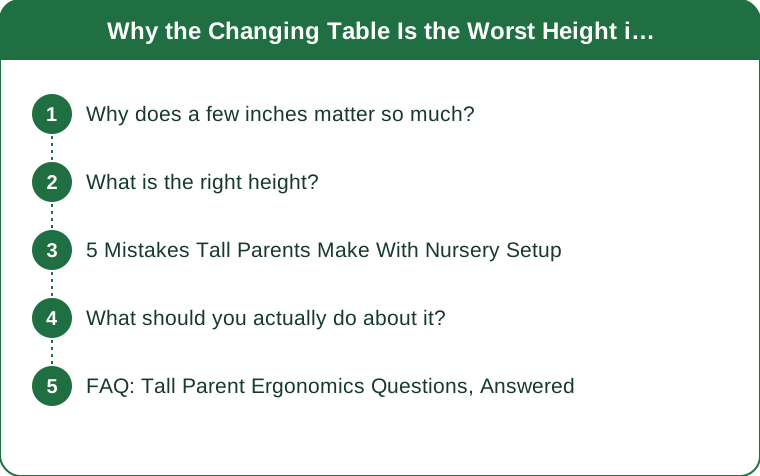
Why does a few inches matter so much?
Because the load is a lever and the repetition is high.
Standing upright, your head and torso sit over your pelvis and the spine carries them efficiently. Lean forward and that weight moves in front of the spine, so the muscles of the lower back have to hold it there. The further forward, the greater the load, and it rises steeply rather than gradually.
A changing surface that is four inches too low does not produce four inches of lean. It produces a bend at the hips and a rounding of the lower back, plus forward reach with both arms, which pulls the centre of mass further forward again.
Then multiply by frequency. Eight to twelve changes a day in the early months, at two to four minutes each, is somewhere around half an hour a day in a sustained flexed posture with intermittent load. Over a year that is a serious total, and the fact that each individual instance is easy is exactly why nobody identifies it as the cause.
The standard height exists because furniture is designed to a population average, usually around 5ft 4 to 5ft 6 for the assumed primary user. If you are 5ft 10, the surface is roughly four to six inches too low for you, and the effect is entirely predictable.
What is the right height?
Roughly your standing elbow height, or an inch or two below.
Stand relaxed, bend your elbows to ninety degrees, and measure from the floor to your forearms. That is your natural working height for a task done with the hands. For most tall women it lands somewhere between 40 and 44 inches, against a standard changing table at 36 to 38.
A surface at that height lets you work with a neutral spine and arms hanging naturally. The difference in how a change feels is immediate and quite striking the first time.
Two important caveats. If a partner of a different height shares the task, you need either a compromise height or two stations, and two stations is often the better answer - one upstairs at one height, one downstairs at another.
And the surface must be genuinely stable at the new height. Raising a changing table on risers is only sensible if the result does not rock, and a taller surface with a baby on it demands more care about edges and straps, not less. A child rolls sooner than parents expect, and height increases the consequence.
The safest versions of this are a chest of drawers of the right height with a changing mat on top, or a wall-mounted fold-down unit installed at your measurement. Both are more stable than a raised freestanding table.

5 Mistakes Tall Parents Make With Nursery Setup
1. Buying the changing table first. It is the most heavily marketed nursery item and the one most likely to be wrong for you. A sturdy chest of drawers at the right height with a mat on top is better, cheaper, and useful for a decade after the nappies stop.
2. Changing on the floor to save space. Understandable and hard on a tall body, since getting up and down from the floor ten times a day with a child is its own load. If floor changes are necessary, kneeling rather than bending is the version that protects your back.
3. Ignoring the cot height. Cot mattress height is adjustable in most models and the top setting is often too low for a tall parent, particularly for lifting a sleeping child out over a fixed side. Set it to the highest setting safety allows for the child’s stage, and lower it when they can pull up.
4. Setting up the bath at the bath. Bathing a baby in a full-size tub is the single worst posture in the whole routine - fully bent, arms extended, and holding weight. A baby bath on a stable raised surface, or a bath support, changes it completely for the months it matters.
5. Fixing the nursery and forgetting the rest of the house. The changing station is one of five or six repetitive stations - the cot, the bath, the pram, the car seat, and the kitchen counter for bottle prep. Solving one and leaving the rest just moves where the pain comes from.
What should you actually do about it?
Measure once and adjust everything to that number.
Measure your elbow height and write it on your phone. Every decision below refers to it.
Set the changing surface at or just below elbow height. Options, in order of preference: a chest of drawers of the right height with a secured mat, a wall-mounted fold-down unit installed to your measurement, or a standard table on stable risers with the stability checked properly.
Always use the safety strap, and never leave the child unattended, especially at a raised height. Everything gained ergonomically is not worth a fall, and a higher surface is less forgiving. Keep everything you need within arm’s reach so you never have to turn away.
Raise the bath station. A baby bath on a sturdy table or counter at working height, for as long as the child is small enough. This is the biggest single win after the changing table.
Set the cot mattress to the highest setting that is safe for your child’s stage, and check the guidance each time you change it.
Look at the pram handle height before buying. Adjustable telescopic handles are standard on better prams and absent on many cheaper ones, and a low fixed handle over a year of daily walking is a genuine problem for a tall parent.
And build a two-minute counter-movement into the day. Standing back extension, a doorway chest stretch, and a few minutes of walking upright with the shoulders back. It does not undo the load, and it interrupts the accumulation.
This is general information rather than medical advice. Back pain that is severe, persistent, or radiating should be assessed by a healthcare professional, and postnatal recovery in particular deserves proper guidance rather than general ergonomics.
FAQ: Tall Parent Ergonomics Questions, Answered
What if my partner is much shorter?
Two stations at two heights is the cleanest solution and is usually cheaper than one perfect compromise. Where that is not possible, set the height for whoever does the majority of changes and let the other person use a small step.
Are adjustable-height changing tables worth it?
The good ones are, and they are genuinely useful in mixed-height households. Check the mechanism is solid and that adjusting it is quick enough that people will actually do it - a table that takes two minutes to adjust will stay at one height.
How long does this actually matter for?
The changing station matters most for roughly the first eighteen months to two and a half years, which is a long time to hold a poor posture ten times a day. The bath and the pram matter for longer, and the kitchen counter matters for the rest of your life, which is worth remembering when you next replace a worktop.
TL;DR:
- Standard changing tables are set for an average adult, so a tall parent works four to six inches too low, ten times a day.
- Forward flexion load rises steeply with lean, and the repetition is what does the damage rather than any single change.
- Set the surface at your standing elbow height, using a chest of drawers or a wall-mounted unit rather than a raised freestanding table.
- Fix the bath, cot height, and pram handle too - solving one station just moves the problem.
The advice tall parents get is to lift with their legs. The more useful advice is to stop bending forward for half an hour a day, and that is a furniture decision rather than a technique one.
Keep Reading
This article is for general informational and styling purposes only. Fit, sizing, and product availability may vary.
