Why a Shopping Cart Hurts Your Back More Than the Stroller Does
Quick Answer: Stroller handles are adjustable and cart handles are not. Standard shopping cart handles sit around 36 to 39 inches, which is well below comfortable pushing height for anyone over about 5’9, so you push with a forward-flexed spine and rounded shoulders — often for 40 minutes, often one-handed while managing a child. The fixes are posture, hand position, and cart choice, and they are all available in the store.
You spent real money getting a stroller with a telescoping handle. Then you push a fixed-height metal box around a supermarket twice a week and wonder why your lower back hurts on Saturdays.

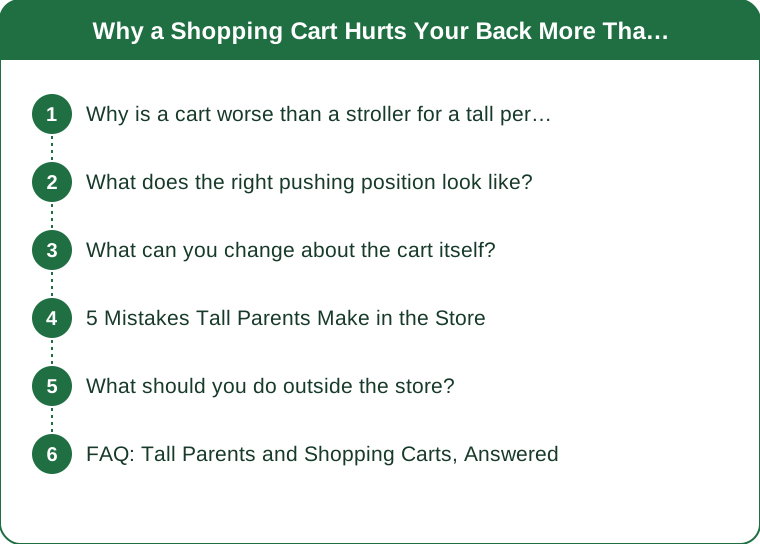
Why is a cart worse than a stroller for a tall person?
Three reasons: fixed height, higher resistance, and worse posture under load.
Fixed height is the main one. Stroller handles adjust — often over a 6 to 8 inch range — and cart handles do not. Standard supermarket cart handles sit roughly 36 to 39 inches from the floor, which is designed around a median adult. For someone 5’10 or taller, comfortable pushing height is more like 40 to 44 inches, so you are reaching down by several inches continuously.
Reaching down to push means flexing forward at the hips and rounding the upper back. That posture increases load on the lumbar spine and puts the shoulders in a position where the upper back muscles cannot contribute much. You end up pushing with your arms and lower back rather than your legs and trunk.
Then resistance. A loaded cart is heavy — easily 60 to 100 pounds by the end of a family shop — and it has four small casters, at least one of which is usually fighting you. A stroller rolls easily on large wheels; a cart resists, wobbles, and pulls to one side. More force through a worse position is the whole problem.
And the child factor. A toddler in the cart seat means one hand on the handle and one hand managing the child, which is asymmetric loading — a single-arm push with a twisted trunk. Asymmetric pushing of a heavy object is considerably harder on the back than symmetric pushing of the same weight.
Duration is the multiplier. A shop is 30 to 50 minutes of near-continuous pushing. A stroller walk may be longer, and the stroller is set to your height and rolls freely.
What does the right pushing position look like?
Closer, taller, and driven from the legs rather than the arms.
Stand closer to the cart than feels natural. Most people push from too far back, arms extended, which forces a forward lean. Step in until your forearms are close to vertical and your elbows are near your sides — this alone corrects most of the spinal flexion.
Push through your legs, not your arms. Think of walking the cart forward with your body rather than pressing it away with your hands. The force should come from your legs and trunk with the arms simply transmitting it. This is the same principle as a sled push, and it is the difference between using your posterior chain and using your lumbar spine.
Keep your ribs stacked over your pelvis. A tall frame has a long lever between the two, so a small forward lean produces a large moment at the low back. Standing tall costs nothing and it is the single most effective correction available.
Use the corners of the handle, not the middle. Gripping wider puts your shoulders in a better position and lets you keep the elbows in. Palms facing inward on the vertical corner posts, where the cart allows it, is often more comfortable than an overhand grip on the crossbar, because it lets the shoulders sit down rather than internally rotate.
Alternate sides whenever you are pushing one-handed. If a child needs a hand, switch which hand is on the cart every couple of aisles. Asymmetric load repeated in one direction for 40 minutes is what produces a one-sided ache.
And stop pulling the cart behind you. Pulling puts the shoulder in extension and internal rotation with a load on it, which is the least favourable position of all. It is also how a lot of people navigate crowded aisles.
What can you change about the cart itself?
More than you would think, and the choices are all free.
Choose the cart deliberately. Cart designs vary within the same store — the compact ones, the two-tier flat carts, and the ones with a child seat all have different handle heights and geometry. The tall two-tier carts used for click-and-collect or the flat platform trolleys often have handles several inches higher than a standard grocery cart. Walk past the first cart in the rank and look for a taller one.
Check the casters before you commit. Thirty seconds pushing an empty cart in a straight line tells you whether a wheel is dragging. A dragging wheel adds meaningful resistance and forces you to push at an angle, which is a twisting load. Swap it — this is the highest-return thing on this page and it takes ten seconds.
Load it low and centred. Heavy items on the bottom rack and in the middle of the basket, not stacked high at the far end. A high, far-forward load makes the cart tip and steer badly, which means more corrective force through your arms.
Use a basket for small shops. A hand basket held close, switched between hands, is easier on a tall back than a cart for anything under about 15 items — and a backpack is easier still.
Consider the alternatives for the big shop. Delivery or click-and-collect removes the whole exposure, and for a tall parent with an existing back complaint that is a legitimate ergonomic decision rather than a luxury. A rolling tote with a long telescoping handle is another genuine option for smaller trips, and unlike a cart, the handle adjusts to you.
And for the child specifically: a toddler in a carrier on your front or back leaves both hands on the handle, which converts an asymmetric push into a symmetric one. It adds weight and it removes the twist, and for most people the trade is worth it.

5 Mistakes Tall Parents Make in the Store
1. Taking the first cart in the rank. Handle heights and wheel condition vary, and the front cart is the one everyone else rejected. Ten seconds of selection changes 40 minutes of pushing.
2. Pushing from too far back. Extended arms force a forward lean and a rounded upper back. Step in close, elbows by your sides. This is free and it is the largest single correction.
3. Keeping the same hand on the cart the whole time. One-handed pushing while holding a child’s hand or steadying a toddler is asymmetric loading, and doing it in one direction for a whole shop is why the ache is always on the same side. Switch every aisle or two.
4. Loading heavy items high. A tall stack at the far end of the basket makes the cart steer badly and tip forward, and correcting that is continuous work through your arms and trunk. Heavy and low and centred.
5. Lifting the child in and out of the cart seat with a rounded back. This is the highest-load moment of the entire trip and it happens at least twice. Get close, hinge at the hips, keep the child near your body, and use your legs. A tall person lifting a 30-pound toddler out of a deep seat at arm’s length is a genuinely demanding lift, and it is the one worth doing deliberately.
What should you do outside the store?
Two strength patterns and one mobility habit, because the store is only one of a dozen too-low surfaces in a tall parent’s day.
The bigger picture is that almost nothing is built for you. Kitchen counters, changing tables, cribs, bathtubs, car seats, prams, and shopping carts are all sized around a median adult, and a tall parent spends a large share of the day flexed forward. The cart is not a special case, it is a visible example.
So train the pattern that resists it:
- Hip hinges — Romanian deadlifts, good mornings, or hip thrusts. 3 sets of 8 to 10, twice a week. This teaches the movement your day demands and builds the muscles that should be doing it.
- Rows and band pull-aparts. 3 sets of 12. Upper back strength is what holds you out of the rounded position under load, and a long torso needs more of it.
- Loaded carries — a heavy bag in one hand, walking tall. This is the direct training equivalent of one-handed cart pushing, and it builds exactly the trunk control that makes the asymmetry survivable.
Then the mobility habit: stand up tall and extend backward gently a few times after any sustained forward-flexed task. Not a stretch routine, just a reset. Doing it after the shop, after bath time, and after the school run costs a minute a day.
And fix the surfaces you own. Cot mattress at its highest setting, changing station on a dresser rather than the floor, a step stool for the child so you are not lifting, and — the one people forget — the kitchen sink, where a small stand or a taller washing-up bowl raises the working height meaningfully.
Timing note: through autumn and into the holidays, shopping trips get longer and heavier while daylight and free time shrink. This is the season where a 40-minute Saturday shop becomes a 70-minute one, which is worth knowing before your back tells you. If back pain radiates into a leg, comes with numbness or weakness, or does not settle with rest, get it assessed. This is general information, not medical advice.
FAQ: Tall Parents and Shopping Carts, Answered
Are there carts designed for taller people?
Not specifically, and the range within most stores is wider than people realise. Two-tier flat trolleys, warehouse-store carts, and the taller click-and-collect trolleys often sit several inches higher than a standard grocery cart. It is worth checking what your usual store has and defaulting to the tallest one that fits your shop.
Is pushing or pulling the cart better?
Pushing, clearly. Pulling puts the shoulder into extension with internal rotation under load, which is a poor position, and it usually involves a twisted trunk as you look where you are going. If aisles are too crowded to push, it is better to reposition the cart than to tow it.
Why does my back hurt after shopping but not after long walks with the stroller?
Because the stroller handle is set to your height, the wheels roll freely, and you push it symmetrically while walking upright. The cart is several inches too low, resists you, and is often pushed one-handed with a twist. Same activity on paper, three meaningful differences in how your spine is loaded.
TL;DR:
- Stroller handles adjust and cart handles do not — standard carts sit at 36 to 39 inches, well below tall pushing height
- Reaching down means a flexed spine and rounded shoulders, with a heavy load and dragging casters adding resistance
- Step in close with elbows by your sides, push through your legs, and grip the handle corners rather than the middle
- Choose the taller cart, test the wheels, load heavy items low and centred, and switch pushing hands every couple of aisles
- Train hip hinges, rows, and loaded carries, and raise the other surfaces you own — the cart is just the visible one
The stroller got solved because it came with a knob. The cart never will, so the adjustment has to be how you stand behind it — closer, taller, driving from the legs, and switching sides before your back picks a favourite.
Keep Reading
This article is for general informational and styling purposes only. Fit, sizing, and product availability may vary.
