Why Holding a Toddler's Hand Wrecks Your Shoulder If You Are Tall
Quick Answer: Holding a small child’s hand forces you into sustained shoulder depression, elbow extension, and a side-bend through your trunk — and the taller you are, the further you have to reach down, so the angle is more extreme. The strain lands in the upper trapezius and the side of the neck. Fixes: switch sides deliberately, bend your knees rather than your spine, and use a wrist-level grip or a walking aid rather than reaching all the way down.
Twenty minutes to the park. By the time you get there, one shoulder is up around your ear and the side of your neck has a dull ache in it.
You are not holding hands wrong. You are holding hands across a bigger height gap than the posture was ever designed for, and sustained low-level load in an awkward position is exactly what produces this kind of ache. The third section covers the compensation that turns a shoulder issue into a lower back one.

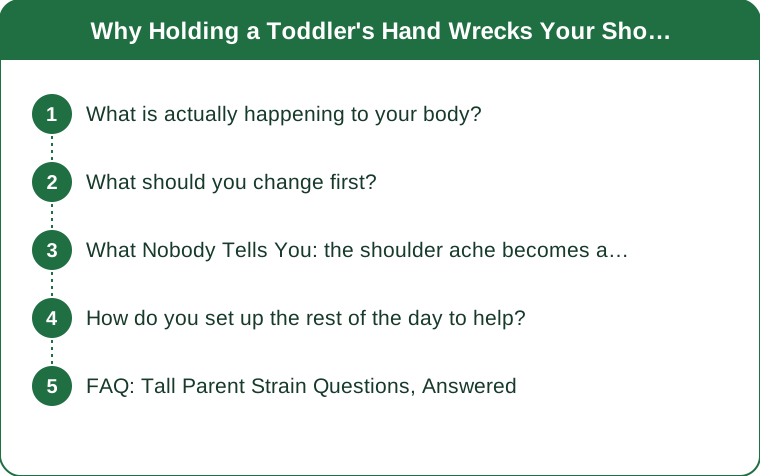
What is actually happening to your body?
Break the position down and the ache stops being mysterious.
To reach a toddler’s hand, your arm has to travel down and slightly across your body. That requires:
Shoulder depression and internal rotation. Your shoulder blade is pulled down and forward, and it stays there. The muscles that hold it in place — including the upper trapezius and levator scapulae — work continuously at low intensity.
A side-bend through your trunk. You lean slightly toward the child to shorten the distance. Over twenty minutes, that is a sustained asymmetric load on one side of your lower back and the opposite side of your neck.
A rotated, extended elbow and wrist. The forearm is doing fine stabilizing work continuously, which is why some people feel this in the forearm and elbow rather than the shoulder.
A shortened stride on one side. Walking at a toddler’s pace while leaning is not your normal gait. Your pelvis moves differently, and the asymmetry runs all the way down.
Height amplifies every one of these. A taller adult has further to reach, which increases the side-bend and the shoulder depression. And a longer arm means a longer lever, so the same load produces more torque at the shoulder.
Add the fact that this is not a one-off — it happens on every walk, every day, on the same side — and you have the classic recipe for an overuse complaint: low load, long duration, high repetition, asymmetric.
What should you change first?
Small changes, applied consistently, because the problem is cumulative rather than acute.
Switch sides every few minutes, deliberately. This is the highest-value change and the hardest to remember, because everyone has a preferred side. Pick a landmark — every block, every crossing — and swap. Setting a rule beats relying on noticing the ache.
Bend your knees, not your spine. When you need to get lower, soften your knees and drop your whole body rather than side-bending your trunk. It looks less efficient and it takes the load off your lower back entirely.
Let your arm hang, do not reach. Aim for a grip where your arm is nearly straight down at your side and your child comes up to meet it, rather than reaching down and across. Some of the strain comes from crossing the midline, which is unnecessary.
Grip the wrist, not the hand, when you can. A wrist hold sits slightly higher and requires less fine grip, which reduces forearm work. It is also more secure near roads.
Slow down and let go more often. A toddler who is holding your hand for safety at a crossing needs to be holding it. Between crossings, on a wide path, hand-holding is often habit rather than necessity — and every minute you are not holding is a minute of recovery.
Consider a toddler walking strap or a backpack with a handle. These sit at a height that does not require you to reach down at all, and for a tall parent that difference is substantial. They are also easier to hold securely for longer.

What Nobody Tells You: the shoulder ache becomes a back ache
Here is the progression that catches people, and why treating this as a shoulder problem alone often does not work.
When your shoulder gets tired, you stop holding it up. The arm stays where it is — the child is still there — so something else has to make up the distance, and what makes it up is your trunk. You side-bend further. Your ribcage shifts. Your pelvis tilts to compensate.
Now the sustained load has migrated from your shoulder to the side of your lower back, which is a larger structure and takes longer to complain but complains louder when it does.
The classic presentation: a parent who describes shoulder tightness for a few weeks and then one-sided lower back pain, and does not connect the two because the shoulder had mostly stopped hurting by the time the back started.
Two things follow from this.
First, if you already have the one-sided back ache, addressing only the back is treating a symptom. The driver is still the daily walk.
Second, the strategy is to reduce the total time in the position rather than to strengthen your way out of it. Strength helps, and the specific work is genuinely useful — but no amount of shoulder strength makes a sustained asymmetric hold a good idea for an hour a day.
The strength work worth doing, as a supplement rather than a substitute: scapular retraction and depression control (rows, face pulls, band pull-aparts), side-lying trunk work for the lateral chain, and thoracic mobility so the side-bend does not have to come entirely from your lumbar spine.
Pain that persists beyond a couple of weeks, radiates down the arm, or comes with numbness or weakness is a see-a-professional situation. This is general information, not medical advice.
How do you set up the rest of the day to help?
The walk is not the only place this load accumulates, and the other places are easier to change.
Car seats and strollers repeat the pattern. Buckling a car seat involves the same reach-down-and-across posture, held while you fumble with a clip. Get into the car or kneel on the seat rather than leaning in from outside — for a taller parent, leaning into a car door frame is a particularly compressed position.
Stroller handle height matters and is adjustable on many models. A handle set too low forces the same shoulder depression continuously, for the whole walk, on both sides. Set it so your elbows are at a comfortable, relaxed angle.
Alternate which hip you carry on. Same principle, different joint. Hip-carrying a toddler is a large asymmetric load, and taller parents carry further from their center of mass.
Watch the lifting-from-the-floor pattern. Repeated bending to pick up a child is where a longer trunk costs the most, because you have more spine to control. Squat or lunge to the floor rather than folding forward.
Build in recovery. Two minutes of doorway chest stretch and a few sets of band pull-aparts in the evening does more than it sounds like, because the problem is a shortened, depressed, internally rotated shoulder held for hours.
Autumn note: as it gets colder, you add a coat, which restricts shoulder movement, and you hold hands with gloves on, which requires a firmer grip. The same walk is genuinely more demanding in November than it was in July, and this is often when a manageable ache becomes a noticeable one.
FAQ: Tall Parent Strain Questions, Answered
Is it bad for the child to hold a hand at that angle?
For a child, a sustained overhead reach is not ideal either, and there are longstanding concerns about pulling a young child up by the arm, which can injure the elbow. Holding the wrist and never lifting or yanking by the hand is safer for both of you.
Will strengthening my shoulders fix this?
It helps with tolerance, and the specific work — scapular control and thoracic mobility — is worth doing. But this is a position and duration problem first. Reduce the exposure, then build the capacity.
How long should it take to improve once I change things?
Overuse aches like this usually respond within a couple of weeks of reducing the load and switching sides consistently. If it is not improving in that time, or if it is worsening, get it assessed rather than continuing to adjust on your own.
TL;DR:
- Hand-holding a toddler forces sustained shoulder depression plus a trunk side-bend, and height makes the angle worse.
- Longer arms mean longer levers, so the same load produces more shoulder torque.
- Switch sides on a rule, bend your knees instead of your spine, and grip the wrist rather than reaching down.
- A tired shoulder shifts the load to your lower back, which is why this often shows up as one-sided back pain weeks later.
- Fix the exposure first — stroller height, car seat approach, hip-carrying side — then add scapular and thoracic work.
The thing that makes this hard to catch is that it never hurts while it is happening. It is twenty comfortable minutes that cost you something you notice at nine in the evening, on the same side, every day. Pick one change to start with — switching sides at every crossing is the easiest — and give it two weeks. Most people find the ache fades before they have gotten around to any of the strengthening work at all.
Keep Reading
This article is for general informational and styling purposes only. Fit, sizing, and product availability may vary.
