Why Baby Gear Causes More Back Pain If You're Tall
Quick Answer: Most baby equipment is designed around an average adult height of roughly 5’4” to 5’7”. For a taller parent, cribs, changing tables, and stroller handles all sit low enough to require repeated forward flexion — which is the loading pattern most associated with back strain. Height-adjustable strollers, raised changing surfaces, and dropside-height cribs solve most of it, and hip-hinging technique solves the rest.
You’re bending for the crib, bending for the changing table, and hunched over the stroller for an hour a day. By month three your lower back is a constant background presence.

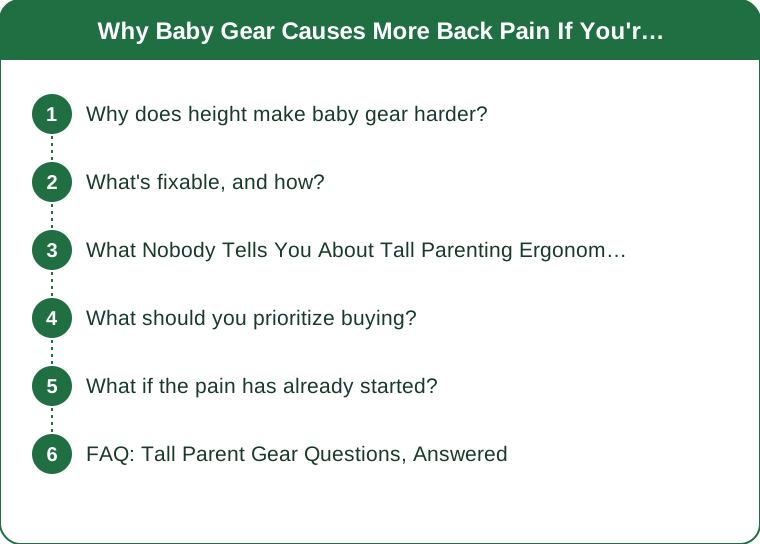
Why does height make baby gear harder?
Because the equipment’s fixed heights determine how much you have to bend, and bending under load is where back strain comes from.
The arithmetic is simple and unforgiving. A changing table at 36 inches requires a 5’4” parent to flex slightly. It requires a 6’0” parent to flex substantially, and to hold that flexion for the several minutes a change takes, several times a day.
Repeated forward flexion with a load — which is exactly what lifting a baby out of a crib is — is one of the more strain-associated movement patterns for the lower back. Doing it a dozen times a day for months compounds.
The specific offenders:
- Cribs, particularly the lowest mattress setting, which is where they end up once the baby can pull up
- Changing tables at standard height
- Stroller handles, which on non-adjustable models frequently force a hunched shoulder position and a shortened stride
- Car seat installation and loading, which involves reaching into a confined space at a fixed height
- Bath tubs and baby baths, involving flexion plus a wet load
None of this is inevitable. Most of it has a specific fix, and the fixes are mostly cheap.
What’s fixable, and how?
Going item by item, because each has a different answer.
Stroller: buy adjustable-handle. This is the single most important purchase decision for a tall parent and it’s worth prioritizing over almost every other feature. Handle height should let you walk with relaxed shoulders and a normal stride without kicking the rear axle. Handle extenders exist for non-adjustable models and are a reasonable retrofit.
Changing table: raise it. Furniture risers, a taller dresser used as a changing surface, or a wall-mounted fold-down at your chosen height. The target is your wrist height when standing relaxed. This is cheap and it’s the fix with the highest daily impact.
Crib: keep the mattress at the highest safe setting for as long as safety guidance allows, then accept that you’ll need to hinge properly. Some cribs have more settings than others — worth checking before buying.
Bath: a bath support that raises the baby, or bathing in a sink or a raised tub rather than the main bathtub, for as long as practical.
Carrier: check strap length ranges before buying. Many carriers have limited strap adjustment and are genuinely too small for taller wearers, particularly for the waist belt position, which needs to sit at your hips rather than your waist.
High chair and play equipment: less critical, but the same principle — anything you’ll be leaning over repeatedly is worth checking the height of.
What Nobody Tells You About Tall Parenting Ergonomics
The technique matters as much as the equipment. Hinging at the hips with a neutral spine, rather than rounding the back, changes the loading substantially. Get close to the crib, hinge, keep the baby near your body, and lift with the legs. This is the same advice given for any lifting, and it applies dozens of times a day here.
Getting closer reduces the load more than you’d think. Holding a load at arm’s length dramatically increases spinal loading compared to holding it against your body. Every inch closer matters. Drop the crib side if it drops, step right up to it, and bring the baby in before lifting.
Car seats are the worst single item. You’re reaching into a confined space, at a fixed height, twisting, with a load. If you can, put the seat behind the passenger side and load from the sidewalk rather than the road, kneel on the seat edge rather than bending in, and turn your feet rather than twisting your spine.
Nursing and feeding positions cause more neck strain for tall parents because the distance from shoulder to lap is greater. Support the baby up to you with pillows rather than curving down to the baby.
Carrying on one hip becomes habitual and is asymmetric. Alternating sides deliberately is worth the effort, because months of one-sided loading produces genuine imbalance.
Most of this is temporary, which is worth remembering. The crib phase is about eighteen months. The changing table phase is shorter. Spending money on fixing the two or three worst items is worth it, and you don’t need to solve everything.

What should you prioritize buying?
In order of return.
1. Adjustable-handle stroller. Highest impact, largest cost, and the item you’ll use most consistently for the longest. Test it by walking with it, not by standing next to it in a shop — the tell is whether your feet hit the rear axle.
2. A changing setup at your height. Not necessarily a purpose-built table. A tall dresser with a changing pad on top is frequently better and more useful afterwards.
3. A carrier with adequate strap range. Try before buying if at all possible, and check the waist belt sits at your hips.
4. Furniture risers. Cheap, and they fix multiple items.
5. A stool or kneeling pad for car seat loading and bath time. Kneeling beside a bathtub is much better for your back than bending over it.
What you don’t need to buy: most of the rest. The high-chair, playpen, and bouncer heights matter far less because you’re not repeatedly lifting from them.
And ask other tall parents. Height-specific gear recommendations are genuinely useful and rarely appear in general reviews, because reviewers of average height never encounter the problem.
This is general information, not medical advice. Persistent back pain during or after pregnancy is worth evaluating with a healthcare professional — postpartum core and pelvic floor changes affect back mechanics independently of equipment height.
What if the pain has already started?
Worth addressing directly rather than waiting it out.
Fix the two worst items first. Usually the changing surface and the stroller. Reducing daily flexion volume is the intervention that matters most, and it works faster than any exercise.
Then address technique for the items you can’t change — the crib, the car seat. Hinge, get close, don’t twist under load.
Then movement. Postpartum core and pelvic floor function directly affect back mechanics, and this is a genuine area where professional guidance helps. A physiotherapist with postpartum specialization is one of the higher-value appointments available and is widely underused.
Watch for the signs that warrant prompt evaluation: pain radiating down a leg, numbness or tingling, weakness, or any change in bladder or bowel function. These aren’t ergonomics problems.
And be realistic about the phase. Sleep deprivation reduces pain tolerance and slows tissue recovery. Some of what feels like an injury during the first months is a normally-recovering body operating under significant fatigue. That’s not a reason to ignore it — it’s a reason to reduce the mechanical load where you can, because you have less recovery capacity available than usual.
This is general information, not medical advice. Consult a healthcare professional about persistent or worsening pain.
FAQ: Tall Parent Gear Questions, Answered
What stroller handle height should I look for?
Enough that your elbows are at roughly 90 degrees with relaxed shoulders while walking. For someone around 6 feet, that’s usually a handle in the 42 to 46 inch range. Many standard strollers top out around 40 inches, which is why the adjustable models matter.
Can I raise a crib mattress higher than the manufacturer allows?
No. Crib mattress height settings are safety-critical — they’re lowered as the baby’s mobility increases specifically to prevent falls. This is one item where the ergonomic problem has to be solved with technique rather than modification.
Are baby carriers adjustable enough for tall wearers?
It varies substantially between models, and it’s rarely in the marketing. Check the published strap and waist belt ranges, and try it on with weight if possible. Some brands are noticeably better for taller wearers, and the difference is worth researching before buying.
TL;DR:
- Baby gear is built around a 5’4”–5’7” average, so every fixed height forces more flexion from a taller parent.
- Prioritize an adjustable-handle stroller and a changing surface at your wrist height.
- Hinge at the hips, get close before lifting, and turn your feet rather than twisting.
- Crib mattress heights are safety-critical — solve that one with technique, not modification.
Most of this phase is temporary, but eighteen months of daily flexion isn’t nothing. Fixing the two worst items is usually enough to change how your back feels by the end of the week.
See It in Motion
Seen here: Maternity Capris with Side Pockets — shop it on bubblelime.com
Keep Reading
This article is for general informational and styling purposes only. Fit, sizing, and product availability may vary.
