Why Carrying a Toddler on Your Hip Hurts More If You Are Tall
Quick Answer: A hip carry works by tilting your pelvis and side-bending your spine to create a shelf. A longer torso means a longer lever arm between the child’s weight and your lumbar spine, so the same toddler generates more load. Switching sides deliberately, dropping the shelf, and using a hip seat solve most of it.
Your shorter friend carries her three-year-old around the farmers market without complaint. You get twenty minutes in and your right lower back is aching.
She is not tougher. Her lever is shorter.

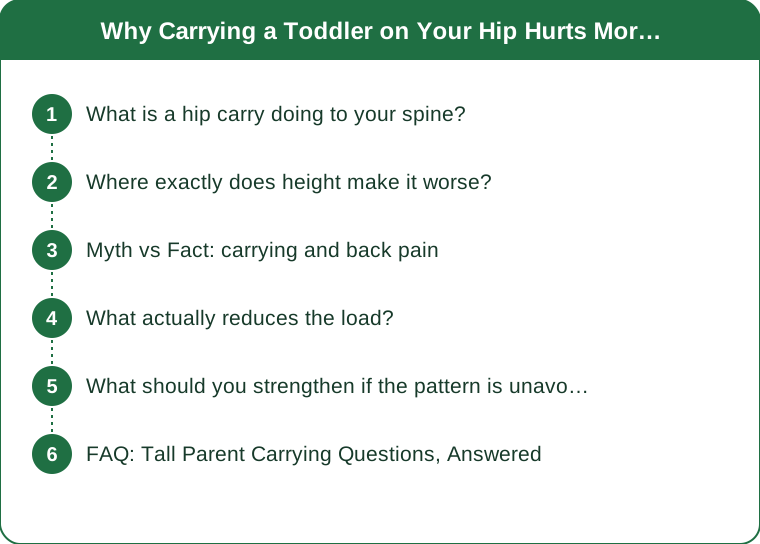
What is a hip carry doing to your spine?
To hold a child on your hip without arms doing all the work, you create a shelf. That shelf is made by hiking one hip up, side-bending the spine toward the loaded side, and rotating the pelvis.
The child’s weight then sits lateral to your spine — offset by roughly 8 to 12 inches depending on your build and the child’s size. That offset is a lever arm, and load times lever arm equals the torque your spine and hip muscles must resist.
The muscles doing the resisting are the quadratus lumborum on the opposite side, the obliques, and the gluteus medius on the standing leg. All three are working isometrically the entire time you are standing there.
So it is not the weight of the child that hurts. It is the sustained sideways torque, held on one side, for as long as you are on your feet.
Where exactly does height make it worse?
Two places.
Torso length. A longer torso means the child’s mass sits farther from your spine’s most stable region and higher relative to your base of support. More distance from the pelvis to the point where your spine can share the load means more of the work falls on a smaller segment.
Arm length and shelf height. Taller people have a higher natural hip shelf, so a toddler sits higher and requires a more pronounced side-bend to create a ledge. That deeper side-bend increases the angle of lateral flexion, and lateral flexion under load is the position lumbar structures tolerate least well.
There is also a pure exposure factor: a taller parent tends to be the one who carries when the child wants to see over a crowd, reaches the top shelf while holding them, and lifts them in and out of high car seats. The height that makes you the designated carrier also makes carrying more expensive.
And if you have been through pregnancy, the abdominal wall and pelvic floor may still be rebuilding capacity, which reduces how much the trunk can share.
Myth vs Fact: carrying and back pain
Myth: You need a stronger core. Fact: Strength helps, but the mechanics matter more. A very strong person holding a sustained lateral load in a side-bent position will still develop symptoms. Change the position before you change the training plan.
Myth: Alternating sides evenly fixes it. Fact: Alternating is essential but almost nobody does it. Most parents carry on their non-dominant side over 80 percent of the time without noticing. You have to set an actual rule, not an intention.
Myth: A carrier is only for babies. Fact: Most soft structured carriers and hip seats are rated to 35 to 45 pounds, comfortably covering a three or four-year-old. Toddler-size carriers exist specifically for this window and are dramatically underused.
Myth: The pain means damage. Fact: Usually it means sustained muscular load in a shortened position. It typically resolves quickly once the pattern changes — though pain that radiates down a leg or persists at rest deserves a professional look.

What actually reduces the load?
Ordered from easiest to most involved.
Switch sides on a rule, not a feeling. Every time you cross a threshold — a doorway, a street, a store entrance — switch. It sounds arbitrary, which is exactly why it works; it removes the decision.
Drop the shelf. Instead of hiking your hip, let the child sit lower and slightly in front, and use both arms. Less elegant, considerably less lateral load.
Use a hip seat. A structured hip seat belt transfers the child’s weight to your pelvis via the belt rather than to your spine via a side-bend. For a tall parent with a heavy toddler, this is the single highest-value $40 to $80 purchase available.
Front carry over hip carry for anything over 5 minutes. A symmetric front or back carry loads the spine evenly. The hip carry should be for short, incidental moments.
Raise the pickup point. Lifting from the floor is where the highest single loads happen. Have the child climb onto a step, a chair, or the couch, then lift from there — that alone removes a large share of the daily total.
What should you strengthen if the pattern is unavoidable?
Some carrying is not optional. Build the tissue that resists lateral load specifically, which is not what most core routines target.
Suitcase carries. Hold a single dumbbell or a heavy grocery bag in one hand and walk 30 to 40 steps with your torso completely upright, then switch. This trains exactly the anti-lateral-flexion capacity the hip carry demands. Twice a week, 3 rounds per side.
Side planks. Start from the knees for 20 seconds per side and build. If you can hold a full side plank for 45 seconds on each side, the hip carry gets noticeably easier.
Single-leg work. Step-ups and split squats build the gluteus medius that keeps your pelvis level when one leg is loaded.
Thoracic rotation. Ten slow open-book rotations per side daily. A stiff upper back forces the lumbar spine to do more of the side-bending.
Give it 4 to 6 weeks at two sessions a week before assessing. And this is general information, not medical advice — pain that radiates, wakes you at night, or does not improve with a change in pattern should be evaluated by a healthcare professional.
FAQ: Tall Parent Carrying Questions, Answered
Is a back carry better for a tall parent?
Usually yes for longer distances. It centers the load and lets your strongest muscles work symmetrically. Check that the carrier has a torso-length adjustment, since standard carriers often sit too low on a long torso and pull at the shoulders.
Why does it hurt more at the end of the day?
The stabilizers doing this work fatigue like any other muscle, and once they do, more load transfers to passive structures. The same carry at 6pm genuinely costs more than at 9am.
Should I stop hip carrying entirely?
No — it is genuinely useful for short moments and it is how toddlers like to be held. Cap it at a few minutes, switch sides religiously, and use a structured option for anything longer.
TL;DR:
- A hip carry loads your spine sideways via a lever arm, and a longer torso lengthens that lever.
- Height also raises the shelf, deepening the side-bend that lumbar structures tolerate worst.
- Switch sides on a fixed rule, drop the shelf, and use a hip seat for anything over a few minutes.
- Train anti-lateral-flexion directly with suitcase carries and side planks.
Your back is not failing you and your friend is not tougher. She is simply carrying the same child on a shorter lever. Change the lever, and the twenty-minute limit tends to disappear within a couple of weeks.
Keep Reading
This article is for general informational and styling purposes only. Fit, sizing, and product availability may vary.
