Why Pushchair Handle Height Costs Tall Parents More Than Lifting Does
Quick Answer: Pushchair handles are typically fixed or adjustable to around 95-105cm, set for average parent height. Ideal handle height is roughly at your hip to lower-waist level — for a tall parent that is often 110-120cm. Pushing below that forces a sustained forward lean and rounded upper back for the whole walk, which loads the low back far more than a few lifts do.
The lifts are brief and forceful.
The pushing is long and low.
Cumulative load wins, and it is the one nobody warns you about.

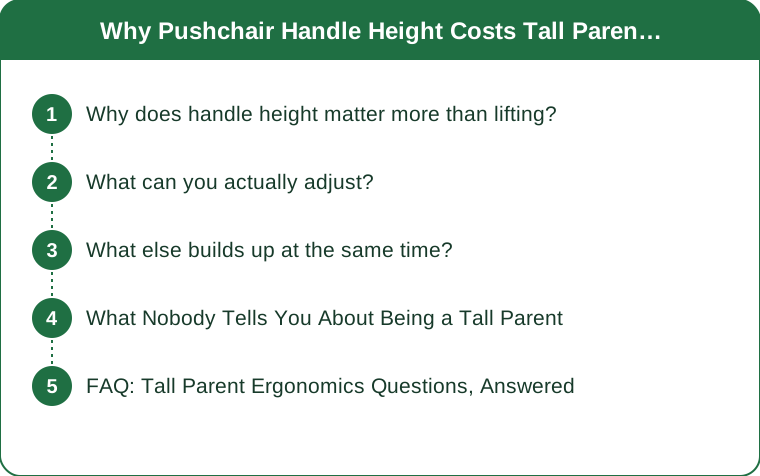
Why does handle height matter more than lifting?
Six reasons duration beats intensity here.
Load equals force multiplied by time. A lift is high force for a couple of seconds. A walk is moderate force for forty-five minutes. Total tissue load from the walk is frequently far greater, and the low back does not distinguish between them.
Low handles force a forward lean. To push at a handle below your comfortable arm position, you lean forward from the hips or round your upper back. Held for an entire walk, that position loads the lumbar spine continuously with no relief phase.
Your arms end up in internal rotation. Pushing low turns the shoulders inward, which shortens the chest and lengthens the upper back muscles. This is the same position that desk work creates, and it compounds with it.
You cannot change position while pushing. Unlike sitting or standing, where you shift constantly, pushing locks you into one posture. There is no natural variation, which is the single most important protective factor in any sustained position.
One-handed pushing makes it worse. Pushing with one hand while holding a coffee, a phone or a toddler’s hand rotates the trunk and loads one side. Most parents do this for a substantial share of every walk.
And the frequency is enormous. Multiple walks daily for years is one of the highest-volume repetitive activities in a parent’s life, and the handle height is set once and rarely revisited.
What can you actually adjust?
Six fixes, from free to worth-buying.
Check whether your handle is adjustable, and set it to its maximum. Many parents never adjust it from the shop setting. Aim for a handle at hip to lower-waist height, where your elbows can stay at roughly 90-100 degrees with relaxed shoulders.
Fit handle extenders if it is not tall enough. These clamp onto the existing handle and add 10-15cm. They are inexpensive, widely available, and for a tall parent they change the ergonomics of every walk. Check compatibility with your specific model and ensure the clamp is secure.
Buy for handle height if you are choosing a pushchair. Telescoping handles with a genuinely tall maximum exist, and the specification is usually published. Test it in the shop by walking with it, not by standing beside it — the difference only appears when you walk.
Push with your hands wider apart. A wider grip reduces internal rotation at the shoulder and opens the chest, which relieves some of the upper back load even at a fixed handle height.
Alternate hands and switch sides deliberately. If you push one-handed, swap every few minutes. It is a small habit that spreads the asymmetric load rather than concentrating it.
Vary the route and take breaks. Stopping to stand upright for thirty seconds every ten minutes interrupts a sustained position that otherwise runs uninterrupted for an hour.

What else builds up at the same time?
Six related loads that stack with the pushing.
Car seat carrying is the worst single load. An infant carrier held in one hand at your side is heavily asymmetric and surprisingly heavy. Carry it with both hands in front of you, close to your body, or use a pram frame attachment. Tall parents carry it further from the ground, which increases the lever arm and the load.
Cot and changing table heights are set for average. A changing table at 90cm means bending for every nappy change, several times a day. Raise it on sturdy risers, or use a chest of drawers of an appropriate height. This is one of the highest-frequency bends in early parenthood.
Bathing is the worst position of all. Kneeling beside a bath and leaning forward over the edge is a deeply loaded position held for ten to fifteen minutes. Sit on a low stool rather than kneeling, and consider a bath support that raises the baby.
Hip-carrying a toddler is asymmetric by definition. Alternate sides consciously, and use a carrier for longer periods. Tall parents often find the toddler sits lower relative to their torso, requiring more lateral lean.
Kitchen counters are the everyday one. Standard counters at 90cm are low for a tall person, and food preparation is a daily forward lean. A raised chopping board of a few centimetres makes a genuine difference.
And strengthen for the load you actually carry. Dead bugs, side planks and hip hinge work, 3 sets of 10, three times a week builds the trunk endurance the days demand. This is general information, not medical advice — persistent back pain, or pain with numbness or weakness, needs a professional assessment, particularly postpartum.
What Nobody Tells You About Being a Tall Parent
Nobody tells you that everything is sized for average. Cots, changing tables, high chairs, car seat bases, bath supports, kitchen counters. Individually each is a small mismatch; together they define your entire day.
Nobody tells you that handle extenders exist. They cost very little, fit most models, and solve the single biggest daily load. Most tall parents find out about them years in.
Nobody tells you the load is duration, not weight. Everyone braces for the lifting. Almost nobody prepares for forty-five minutes of pushing in a bent position, twice a day, for three years.
Nobody tells you that clothing matters here too. Leggings that ride down when you bend repeatedly, or a top that rides up every time you lift, means constant adjustment through a day that already involves a hundred bends. Longer-rise, longer-body cuts are a practical choice rather than a vanity one.
Nobody tells you to test baby equipment by using it, not looking at it. Push the pushchair around the shop. Mime a nappy change at the changing table height. The mismatch only appears in the movement.
Nobody tells you that early autumn is when it bites. Walks get longer and more frequent as the weather turns comfortable, layers add bulk that changes how you carry things, and the accumulated hours rise just as the days shorten. Sorting handle height in September pays off all season.
FAQ: Tall Parent Ergonomics Questions, Answered
What height should a pushchair handle be?
Roughly at your hip to lower-waist level, with elbows at 90-100 degrees and shoulders relaxed. For many tall parents that is 110-120cm, above most standard maximums.
Do handle extenders actually work?
Yes. They add 10-15cm, cost little, and fit most models. Check compatibility and that the clamp is secure before loaded use.
Why does pushing hurt more than lifting?
Because total load is force times duration. Forty-five minutes of moderate load in a fixed forward lean exceeds a few seconds of heavy lifting.
How should I carry an infant car seat?
Both hands, in front of your body, close in. One-handed carrying at your side is heavily asymmetric and the most common cause of one-sided pain.
What height should a changing table be?
Around your hip height so you are not bending. Raise a low one on sturdy risers rather than living with it.
What exercises help?
Dead bugs, side planks and hip hinges, 3 sets of 10, three times a week. Trunk endurance is what the day actually demands.
When should I see someone?
Persistent pain beyond a few weeks, or any numbness, tingling or weakness, needs professional assessment — especially in the postpartum period.
TL;DR:
- Handle height matters more than lifting because load is force times duration, and pushing lasts far longer.
- Aim for a handle at hip to lower-waist height, elbows at 90-100 degrees.
- Handle extenders add 10-15cm for very little money and fix the single biggest daily load.
- Carry infant seats with both hands in front, raise changing tables, sit for bathing.
- Build trunk endurance with dead bugs, side planks and hip hinges, 3x10, three times a week.
Go and measure your pushchair handle against your hip right now. If it is below, extenders are the best twenty pounds you will spend this year.
See It in Motion
Seen here: Maternity Capris with Side Pockets — shop it on bubblelime.com
Keep Reading
This article is for general informational and styling purposes only. Fit, sizing, and product availability may vary.
