Why the Kitchen Sink Is the Worst Height in a Tall Parent's House
Quick Answer: Standard counter height is set around an average user, and a sink basin sits several inches below the counter surface - so the working point for washing is effectively lower still. For a taller person that means sustained forward flexion of the spine, repeated many times a day during the bottle-and-cup years. The fix is raising the work, not lowering yourself. A basin insert or a washing-up bowl inside the sink is the cheapest large improvement in the house.
The counter is low.
The sink is lower - and that is where the hours actually go.

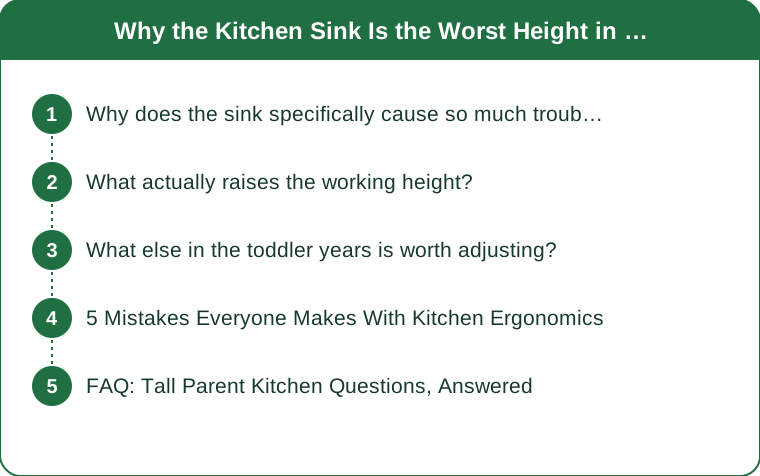
Why does the sink specifically cause so much trouble?
Because the working surface is below the counter, and the volume of use in early parenting is enormous.
Standard counter heights are built around an average user. They are a compromise, and the compromise favours the middle of the distribution. For anyone well above average, standard height requires a bend for every task.
And the sink is not at counter height. The basin floor sits several inches below the counter, so the actual point where your hands work is lower than any other kitchen task. The sink is the lowest work surface in the room, and it is the one used most.
Sustained forward flexion is the specific problem. It is not the depth of the bend so much as the duration and repetition. Static bending loads the lower back far more than movement does, and washing up is static bending by definition.
The toddler years multiply the frequency. Bottles, sippy cups, weaning bowls, and the constant rinsing of small things means many separate trips to the sink daily. The task count is what changes, and it changes for a few years.
Carrying compounds it. A tall parent is also lifting a child from a floor-level position repeatedly. The back that is already tired from the sink is then asked to do the lifting.
And nobody flags it, because everyone has a low sink. It reads as a normal part of parenting rather than as an ergonomic problem with a fix.
What actually raises the working height?
Four options, in order of cost, and the cheapest one works well.
Put a washing-up bowl or basin insert into the sink. This raises the working surface by several inches instantly and costs almost nothing. This is the single highest-value change available and takes thirty seconds to try.
Use a bottle drying rack rather than laying things flat. Vertical storage means less reaching into the basin and less time spent bent over. A tall rack keeps the work at counter level.
Move bottle washing to a different station entirely. A basin on the counter, or an electric steriliser at counter height, removes the sink from the equation for the highest-frequency task. This is what actually solves the toddler years.
Reconsider the dishwasher loading position. A dishwasher below counter level is another sustained bend. Loading in two batches while kneeling on one knee is better for your back than standing and bending repeatedly.
If you are renovating, raise the counter. Counter height is adjustable at the point of installation, and a raised run - even just the sink section - transforms a kitchen for a taller person. This is the only permanent fix, and it costs nothing extra if done during a planned renovation.
And split the height if you can. A lower section for children and food prep and a raised sink run is a very common solution and looks entirely normal.

What else in the toddler years is worth adjusting?
The same principle applied to four other daily tasks.
The changing surface. Standard changing tables are commonly too low, and this is the most repeated bend of the first year. Raise it with a firm platform or use a chest of drawers of the right height - the correct height is roughly at your hip.
The cot mattress height. Lifting a child from a low mattress at full arm extension is a hard lift. Keep the mattress at its highest safe setting for as long as the manufacturer allows, and lower it only when required.
The stroller handle. A handle that is too low forces a forward lean over every walk. Adjustable-height handles exist and are worth prioritising over almost any other stroller feature if you are tall.
Floor play position. Sitting cross-legged with a rounded back for long stretches is hard on a long spine. Sit against a wall, or on a low cushion to raise your hips above your knees, which lets your back stay neutral.
And the car seat. Installing and buckling from outside a car door is an awkward, twisted, extended reach. Kneel on the seat rather than leaning in from outside - it converts a twisted reach into a supported one.
Persistent back pain deserves proper assessment, particularly in the postpartum period when tissue tolerances are still changing. Ergonomics helps a lot; it does not replace a physio. This is general information, not medical advice.
5 Mistakes Everyone Makes With Kitchen Ergonomics
Assuming the counter is the problem and the sink is fine. The sink is lower than the counter and used more. Fix the sink first - it is where the hours are.
Buying a taller stool instead of raising the work. Standing on something to reach high shelves is fine; nothing helps the bend at the sink except raising what you are working on. Raise the object, not yourself.
Doing all the washing in one long session. Sustained flexion for twenty minutes is much worse than four sessions of five. Break it up, or use the dishwasher for anything that can go in it.
Ignoring foot position. Standing with both feet square at a low sink maximises the bend. Put one foot on a low step or the open cupboard base - it tilts the pelvis and reduces the lower-back load noticeably.
Waiting for a renovation to fix it. The renovation may be years away and the toddler years are now. A five-pound washing-up bowl today beats a perfect kitchen in three years.
And the bonus mistake: not asking for the height you want when you do renovate. Counter height is a choice, not a fixed dimension, and installers will build to a specified height. Nobody offers - you have to ask.
FAQ: Tall Parent Kitchen Questions, Answered
What counter height should a tall person actually have?
A useful starting point is a surface where your hands rest comfortably with your elbows slightly bent while standing upright. Measure from the floor to just below your bent elbow and use that as a reference - it will usually be above standard.
Is a raised sink section expensive to add?
During a planned renovation, raising one run of counter is typically a minor cost. Retrofitting into an existing kitchen is more involved, which is why the basin-insert workaround matters so much in the meantime.
Does it really make a difference, or am I just tired?
Both can be true. Try the washing-up bowl for a week - if the difference is noticeable, the ergonomics were a real contributor. It is a cheap experiment with a clear answer.
TL;DR:
- The sink basin sits below counter height, making it the lowest and most-used work surface in the house.
- Sustained forward flexion, repeated many times a day is the specific load - duration matters more than depth.
- A washing-up bowl or basin insert raises the working height instantly for almost nothing.
- Move bottle washing off the sink entirely during the high-frequency years.
- Put one foot on a low step while standing at the sink - it reduces lower-back load immediately.
Put a bowl in your sink tonight and wash tomorrow’s bottles in it. If your back notices, you have found a fix that costs almost nothing.
Keep Reading
This article is for general informational and styling purposes only. Fit, sizing, and product availability may vary.